What is Aftershock after Narcissistic Abuse?

“When a toxic person can no longer control you, they will try to control how others see you. The misinformation will feel unfair, but you stay above it, trusting that other people will eventually see the truth just like you did.” – Jill Blakeway



Aftershock after narcissism abuse is a phenomenon that is little understood. The road to recovery is not easy at all and this might leave you second guessing yourself.

Logically, you think after leaving the abusive relationship, you should start recovering, right? but suddenly the aftershock sets in and the onslaught of months, years or even decades of abuse hits you like a jet plane.

Why is this happening to me?

Let me explain why this is happening to you. Once you are out of survival mode and have some time to think, to feel and to realize the extent of the narcissistic abuse that has taken place. You start feeling overwhelmed, deep despair and total heartbreak. You almost become obsessed trying to make sense of what happened to you, what could have happened and what should have happened and ultimately end up with more questions than answers.

The aftershock will drain you emotionally, to the point where you can barely function. You can’t get out of bed, you can’t sleep, you lose your appetite and your anxiety level is at it’s max. The future looks bleak and you feel hopeless.

Suffering from aftershock is more common than you think. We are human after all.

You also might feel like taking revenge at the end of the relationship, but a narcissist don’t play fair, so do not try to defeat the narcissist while you are suffering from aftershock, you are going through a lot already. The narcissist will see you as the enemy and try to destroy your credibility with smearing and want to dismantle your ability to move on.

Many don’t do well during this phase, understandably, because they don’t know how to get relief during the aftershock period.

The good news is, that you will get through it, healing takes time, don’t force yourself. Firstly, gain an understanding of what narcissistic abuse is, so that you can make sense of what happened to you.

Commit to self-healing, empower yourself and try to work through your emotions and more importantly get support. As you get better, the disconnection with the narcissist become real, you are less triggered and the aftershock period becomes manageable.

Your self-healing journey will bring relief, the negative emotions will melt away and everything will start coming together gradually, because your internal self is healing.

“You don’t attract narcissists because something is wrong with you. You attract narcissists because so much is right with you.”
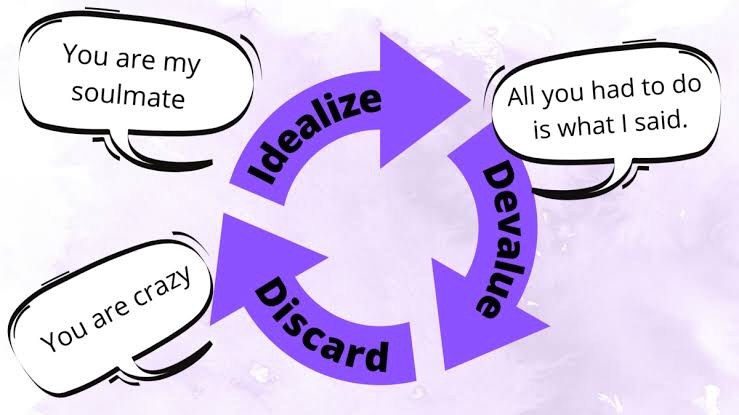

The Narcissist Abuse Cycle.

“People will come into your life and test if you love them more than you love yourself. Don’t let anyone make you forget to love yourself first”.


There is distinct phases these relationships typically go through, whether it’s with your partner, parent, sibling or friend.

Idealization, devaluation and discard, this cycle will be on repeat for the longest time.

The first phase: Idealization

This phase occurs right at the beginning of a relationship, another term used for this phase is “love-bombing”. This is where they shower you with love, adoration, gifts and beautiful gestures and present themselves exactly to be who they think you want them to be. This phase is perhaps also the most dangerous as they reel you in. Perhaps the saying, “if it’s too good to be true, it probably is”, comes to mind, right?

During this phase, you feel as if you can’t get enough of this person, probably can’t believe you found someone so “in-tune” with your energy. They will make you feel so good that you may just so ignore the subtle warning signs.

You will become so consumed, that even if some red flags pop-up, you quickly have an explanation for them.

I want to make this clear, this phase also applies to familial bonds, between narcissistic parent and their children. (I will give more insight on this in my next blog)

The second phase: Devaluation

After you’re completely reeled in, subtle manipulative tendencies will creep in your relationship, perhaps running down your closest friends and family members to ultimately isolate you, which leaves you relying on them completely. They might use phrases like, “it’s us against the world” making you believe that you are on solid ground with them.

After a while they will start lying to you, rewrite history to escape accountability and confuse you from your reality. They will become verbally abusive, insult and accuse you, blame and shame you, threaten you, guilt-trip you and ultimately withhold the very things that made you fall for them in the first place, knowing that you rely on them.

You will not be save from sarcasm, humiliation in front of others and after a while suffer from low self-esteem. They may become aggressive as to shock you into submission, becoming fearful of them. At worse they even might become physically abusive.

Unfortunately, it is common for the victim to make excuses, because they did a pretty excellent job during the first phase. The narcissist will also mix some of the initial “love-bombing” in there as part of his/her tactics to keep you on your toes and confused at all times and it usually works out perfectly in their favor.

These manipulative tactics, will cause you to start self-doubting yourself, leaving you in a fog and confused. Your self-esteem will be stripped and you will feel like you aren’t good enough or can’t do anything right.

The third phase: Discard.

The narcissist always looks out for themselves. Hunting their prey in the beginning of the relationship gave them an ego boost, the “chase” was on and that excited them. Once they sucked you dry and you no longer give them a “high” or feed their “supply”, you will be thrown out like old socks OR the toxic cycle starts all over again if you unfortunately don’t get out after this phase.

Learn the signs, empower yourself. You deserve to be happy.

Self-Doubt after Narcissism abuse.

“Narcissists will destroy your life, erode your self-esteem, and do it with such stealth as to make you feel that you are the one that’s letting them down.”


Self doubt is very common among adults who were raised by narcissistic parents, but a narcissist may be anyone who has a tremendous impact on your life, whether, a parent, intimate partner or sibling.

You will have gradually fallen victim to a narcissist psychological conditioning – to the point where you detach from your sense of reality. Finally, the narc has you consumed with self-doubt and you are now easily controlled.

This personally happened to me, I grew up hearing how I would never amount to anything. My father would go as far as telling me that I owe him and I felt as if I should work extra hard to pay my “debt” almost being his slave.

My father blamed and shamed me for his financial problems, marital issues with my mother and even for his unfinished projects. I couldn’t understand why, unfortunately the frequency of this abuse made me believe him and I would apologize for it (self-doubt).

Learn the warning signs – Knowledge is power.

1. Self-Importance.

2. Immature and Selfish behavior.

3. Brags about your achievement to others but rarely ever validates you, acknowledges you, or support you emotionally.

4. Well-liked by others but controlling or harsh behind closed doors.

5. Makes you feel anxious and often lowers your confidence.

This is just some of the signs, be careful. Empower yourself. A narc will challenge your reality through confusion.